This article discusses Raspberry Pi 5 hardware features, software specifications, pinout, applications, and importance. Let’s start.
Introduction:
● Raspberry Pi 5 is more advanced and significant than its predecessor Raspberry Pi 4. It uses a quad-core ARM Cortex-A76 processor.
● It offers a memory range of up to 16GB of LPDDR4x RAM, which makes it more demanding and ideal for complex applications.
● It has dual 4K HDMI outputs.
● It has improved Broadcom VideoCore VII GPU and enhanced networking capabilities including Wi-Fi 6 and Gigabit Ethernet. These features make them ideal and reliable for more advanced projects.
● It is reliable for demanding applications like media streaming, machine learning, and data analysis.

Hardware features of Raspberry Pi 5:
The hardware specifications of Raspberry Pi 5 are mentioned below in detail.
Processor:
The most improved and enhanced feature of Raspberry Pi 5 is its processor which is ARM Cortex-A76. This 64-bit chip requires a clock speed of 2.0 GHz to operate efficiently. It improves single-thread and multi-thread performances, making it more reliable for computer-intensive tasks such as virtualization, large-scale simulation, and compiling software.
Raspberry Pi 5 has a fast and efficient CPU, which allows it to perform tasks efficiently. It can smoothly perform tasks like data analysis, multi-tasking workloads, and complex algorithms.

Feature | Detail |
CPU | 64-bit ARM Cortex-A76 processor |
Number of cores | Contains 4 Quad cores |
Clock speed | 2.0 GHz |
Performance | It is up to 50% faster |
Memory (RAM):
It has 16 GB memory of LPDDR4x RAM. It is a significant advancement in Pi 5 as previous boards have 8GB memory. This feature makes them capable of handling complex tasks and larger datasets. It has a faster speed for transferring data. It is crucial in faster memory access applications like image processing, database management, and data visualization. It is ideal in a professional environment because it handles memory-intensive tasks.
Download the Raspberry Pi 5 Datasheet

Specification | Details |
RAM Type | LPDDR4x |
RAM Option | 4GB, 8GB, 16GB |
RAM Speed | 4266 MHz |
Graphics (GPU):
GPU:
The Raspberry Pi 5's Broadcom VideoCore VII GPU has more advanced features that enhance performance. It is ideal for 4k monitors handling them at 60Hz, crucial in performing tasks like media centers, gaming, or digital signage.
APIs Supported:
With superior functional APIs such as Vulkan and OpenCL supported by this GPU, smoothening video playback, GPU’s computation, machine learning, or image processing are all technically feasible.
The maximum resolution of the Pi 4 was 4K at 30Hz which was a limitation, however, with the Pi 5, the resolution has extended to 4K at 60Hz which enables it to be ideal for streaming videos or media, and home theater systems.
Storage:
Storage is crucial for performance and Pi 5 allows the following options.
Primary storage;
The available storage is important for operating efficiently, and Raspberry Pi 5 has a UHS-I MicroSD card slot as the only affordable option for it.
Secondary storage:
Through an adapter, NVMe SSD support provides read and write speeds up to 10x of SD cards.
External storage:
Includes the ability to boot from USB storage devices.
With these enhancements, the Pi 5 achieves shorter booting times, lower data retrieving latencies, and increased reliability for overload applications.
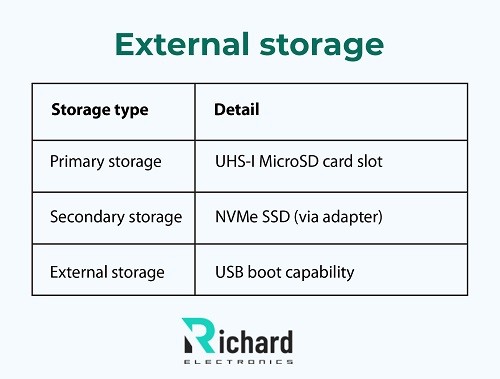
Storage type | Details |
Primary storage | UHS-I MicroSD card slot |
Secondary storage | NVMe SSD (via adapter) |
External storage | USB boot capability |
Connectivity:
Wifi and Bluetooth:
Wi-Fi 6 (802.11ax):
Allows faster wireless speeds and more efficient performance even in highly dense environments.
Bluetooth 5.2:
Low energy, large range, and faster data rate make Bluetooth ideal in IoT projects.
Ethernet:
Gigabit Ethernet allows quick and stable wired network connections which can be useful for server applications or stressed network activities.
USB:
USB 3.0 Ports:
Two high-speed ports are available for connecting external storage, a camera, or a USB-to-Ethernet adapter.
USB 2.0 Ports:
It also provides two other standard additional ports for basic peripherals.
These connectivity options make the Raspberry Pi 5 a versatile option for networking, IoT gateways as well as multimedia devices.

Types | Details | Uses |
Wifi | Wi-Fi 6 (802.11ax) | Used in high-speed wireless IoT and streaming |
Bluetooth | Bluetooth 5.2 | Long-range, low-power IoT and peripherals. |
Ethernet | Gigabit Ethernet | Reliable wired networking for servers. |
USB 3.0 | 2 high-speed ports | External storage, cameras, fast peripherals. |
USB 2.0 | 2 standard ports | Keyboards, mice, and basic peripherals. |
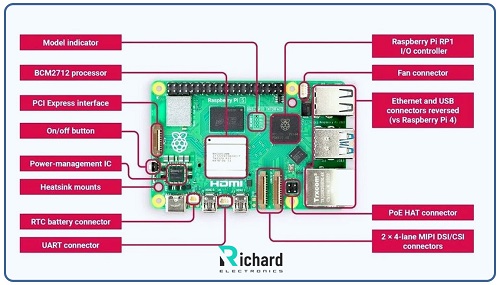
Display and Camera Interfaces 1.6:
The Raspberry Pi 5 can work with various displays and camera modules.
Dual Micro-HDMI 2.1 Ports:
Lets users extend the display on two different external monitors which is advantageous for work multitasking.
MIPI CSI-2 Camera Ports:
It offers the capacity to connect two cameras at the same time, allowing stereo vision and depth mapping.
Video Standards:
Also, the camera can capture video with HDR and 10bit of color depth allowing for realistic scenes.
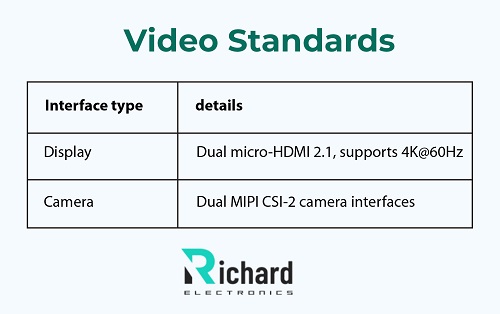
Interface type | details |
Display | Dual micro-HDMI 2.1, supports 4K@60Hz |
Camera | Dual MIPI CSI-2 camera interfaces |
Software features of Raspberry Pi 5:
It has a versatile software ecosystem, that allows various operating systems and tools to enhance its features. Software key features are mentioned below.
Raspberry Pi OS ( Official Operating System):
Raspberry Pi OS, which is based on Debian Linux, is the recommended operating system for the Pi. It consists of an LXQt desktop which is quite lightweight which makes it fit for devices with fewer resources. Some of the software available on the machine includes:
● Chromium web browser for web browsing
● LibreOffice for document creation
● Geany (text editor) and Thonny IDE for Python programming
● Scratch for educational programming
These tools make Raspberry Pi OS a complete solution for the users be they beginners or advanced users.
Multiplatform:
There are several OSs supported by Raspberry Pi 5 to cater to different requirements:
● Ubuntu: It is offered in both desktop and server versions. The Ubuntu 22.04 LTS has been considered suitable for a normal-purpose computer as it comes with long-term support for its applications.
● Windows 10 IoT Core: A variant of Windows that has been deemed appropriate for Internet of Things (IoT) use, it offers a non-desktop view for embedded devices
● LibreELEC: A Kodi-based operating system that helps to convert the Pi 5 into a home theater pc, and helps stream 4k videos and other multimedia features.
Performance Optimizations:
The operating system is designed for the high-end CPU architecture and GPU hardware equipped with Cortex-A76 and VideoCore VII respectively, which allows for effective multithreading, increased smoothness during graphical tasks, and more efficient video playback. The Pi 5 offers an experience where its hardware instantly responds to its commands as they have advanced processing power.
Software installation and development:
The Pi 5 makes it simple to install extra software via the Pi Applications store, offering a range of tools for development, multimedia, and education. It also has strong support for programming in Python and Scratch, which makes it perfect for learning and prototyping.
Pinout:
Pin functions:

Pin | Physical pin | GPIO pin | Function |
1 | Pin 1 | N/A | 3.3V Power |
2 | Pin 2 | N/A | 5V Power |
3 | Pin 3 | GPIO 2 | I2C SDA (Data Line) |
4 | Pin 4 | N/A | 5V Power |
5 | Pin 5 | GPIO 3 | I2C SCL (Clock Line) |
6 | Pin 6 | N/A | Ground (GND) |
7 | Pin 7 | GPIO 4 | Digital Input/Output pin |
8 | Pin 8 | GPIO 14 | UART TXD (Transmit) |
9 | Pin 9 | N/A | Ground (GND) |
10 | Pin 10 | GPIO 15 | UART RXD (Receive) |
11 | Pin 11 | GPIO 17 | Digital Input/Output pin |
12 | Pin 12 | GPIO 18 | PWM (Pulse Width Modulation) |
13 | Pin 13 | GPIO 27 | Digital Input/Output pin |
14 | Pin 14 | N/A | Ground (GND) |
15 | Pin 15 | GPIO 22 | Digital Input/Output pin |
16 | Pin 16 | GPIO 23 | Digital Input/Output pin |
17 | Pin 17 | N/A | 3.3V Power |
18 | Pin 18 | GPIO 24 | Digital Input/Output pin |
19 | Pin 19 | GPIO 10 | SPI MOSI (Master Out Slave In) |
20 | Pin 20 | N/A | Ground (GND) |
21 | Pin 21 | GPIO 9 | SPI MISO (Master In Slave Out) |
22 | Pin 22 | GPIO 25 | Digital Input/Output pin |
23 | Pin 23 | GPIO 11 | SPI SCLK (Clock Line) |
24 | Pin 24 | GPIO 8 | SPI CE0 (Chip Enable 0) |
25 | Pin 25 | N/A | Ground (GND) |
26 | Pin 26 | GPIO 7 | SPI CE1 (Chip Enable 1) |
27 | Pin 27 | GPIO 0 | Digital Input/Output pin |
28 | Pin 28 | GPIO 1 | Digital Input/Output pin |
29 | Pin 29 | GPIO 5 | Digital Input/Output pin |
30 | Pin 30 | N/A | Ground (GND) |
31 | Pin 31 | GPIO 6 | Digital Input/Output pin |
32 | Pin 32 | GPIO 12 | PWM (Pulse Width Modulation) |
33 | Pin 33 | GPIO 13 | PWM (Pulse Width Modulation) |
34 | Pin 34 | N/A | Ground (GND) |
35 | Pin 35 | GPIO 19 | PWM (Pulse Width Modulation) |
36 | Pin 36 | GPIO 16 | PWM (Pulse Width Modulation) |
37 | Pin 37 | GPIO 26 | Digital Input/Output pin |
38 | Pin 38 | GPIO 20 | Digital Input/Output pin |
39 | Pin 39 | N/A | Ground (GND) |
40 | Pin 40 | GPIO 21 | Digital Input/Output pin |
Power pins:
● Pin 1: 3.3V (Power)
If you want to power some devices, for example, sensors, this pin provides 3.3 V voltage, but only if there are not too high of current draws.
● Pin 2: 5V (Power)
If there’s a need to power any external component or board such as a display, or motor thereby using the Raspberry Pi 5 to provide more current on this pin then this pin is useful.
● Pin 4: 5V (Power)
In the GPIO header, one more pin for a 5V power supply is given.
● Pin 17: 3.3V (Power)
This pin acts as a second 3.3-volt pin.
Ground pins:
These pins are essentially used to provide ground connection and complete the circuits to external equipment if any are used.
GPIO Pins (General Purpose I/O):
These GPIO pins are used digitally for input and output activities. They can be programmed to:
● Read from sensors (input).
● Control devices like LEDs, motors, and relays (output).
● Also perform other functions such as interrupt handling, PWM, and others.

I2C:
Pin 3 (SDA) and Pin 5 (SCL) smooth the path for I2C communication. These pins are used to link several sensors and displays.
SPI:
Pins 19 (MOSI), 21 (MISO), 23 (SCLK), 24 (CE0), and 26 (CE1) are inserted in SPI communication. They allow fast data transfer between Raspberry Pi and SPI devices such as ADCs, DACs, and sensors.
UART:
Pins 8 (TXD) and 10 (RXD) are involved in UART communication, the standard for serial communication between the Raspberry Pi, embedded controllers, and other devices.
PWM:
Pins 12, 32, 33, 35, and 36 deliver Pulse Width Modulation (PWM) control signals to the outboard motors, LED chips, and other devices in which variable control signal is crucial for functioning.
Applications:
Due to its advanced and significant features, it has various applications in many fields:
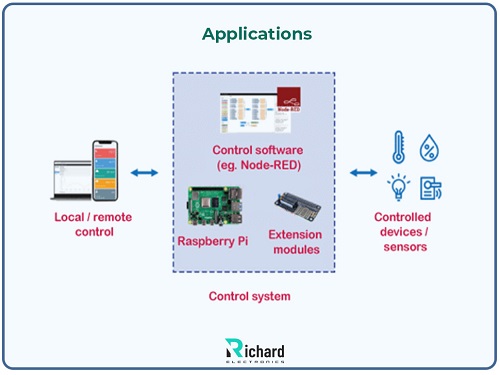
Home Automation:
Raspberry Pi 5 is capable of constructing systems, especially smart home systems, easily interfacing with modules such as sensors or using its proprietary I2C, SPI, and UART communication. It is possible to control water, power, and security as well as real-time monitoring through smartphone applications where the home has various devices i.e. cameras and sensors.
Robotics:
Raspberry Pi 5 is commonly the brain of robots. It offers functionality to drive motors, analyze sensor input as well as run complex algorithms which makes it applicable in building autonomous vehicles, drones, robotic arms, and so on.
Media Center:
The Pi 5 can be utilized as a home multimedia center (with OSMC or Kodi) and allows users to play video and hear music on the HDMI or stream over the network.
Internet of Things (IoT):
The newest version of the Raspberry Pi – version 5 is perfect for Internet of Things (IoT) devices due to its built-in wireless dongles (Wi-Fi, Bluetooth),. It is capable of acquiring data from various sensors and controlling devices which can be used for smart farming, automated surveillance, and environmental monitoring.
Education:
The Pi 5 can be successfully applied to the classroom for education in programming and electronics. It is the best platform for programming and support for Python, Java, and C+.
Conclusion:
It is a more powerful board with high processing speed and a wide memory range. This allows it to support various uses, from learning and robotics to media and connected devices. The Pi 5 can handle today's computing needs with its support for two 4K displays at 60Hz, Wi-Fi 6, and Bluetooth 5.2. This makes it a good fit for tasks that need high performance.
Because of the presence of an enhanced GPIO header and two additional camera ports, the Raspberry Pi is well-suited for applications in the fields of robotics, automation, and computer vision projects. It has attractive cost and significant features so it is ideal for business, in schools, and best suited for hobbyists. This depicts the great progress that has emerged in the era of single-board computers.
It is possible to perform both DIY hobbies and larger commercial endeavors with the most powerful, inexpensive, and multifunctional devices available. The Raspberry Pi 5 offers the speed and consistency that are required for building robotics, media centers, and IoT-based solutions as well.
Related Articles:
- 1.
What processor does Raspberry Pi 5 use?
Raspberry Pi 5 uses a quad-core ARM Cortex - A76 processor with a 2.0 GHz clock speed.
- 2.
Where can Raspberry Pi 5 be applied?
It can be applied in home automation, robotics, media centers, Internet of Things and education.
 Ling Tianhao
Ling Tianhao, with 20 years in R&D, has developed his skills at one of America's top ten chip manufacturers.His expertise goes beyond chip design and quality control, showing a strong understanding of PCB technology. His comprehensive knowledge of microchip and PCB technologies establishes him as a versatile professional in the semiconductor industry, driving advancements and solving complex problems.


04 September 2026
05 August 2026

04 July 2026
06 June 2026
07 May 2026